Chow Chow: The Complete Breed Guide to Temperament and Care
The Chow Chow is one of the most recognisable dogs on the planet. The lion's mane. The blue-black tongue. That slightly stiff, stilted walk.
It's also one of the most misunderstood.
People will tell you Chows are aggressive, stubborn, one-person dogs who can't be trained. I've worked with over 50 Chows, and I run Chow Chow Community | The Home Of Chow Chows, a Facebook group with over 41,000 members. What I see, again and again, is a calm, clean, loyal dog who's been judged on a few bad stories.
So this is the guide I wish every new owner had read. It's built on the breed standards, veterinary research and behaviour science. Where something is opinion or experience, I'll say so.
In this guide
- Chow Chow at a glance
- What the breed standards say (UK, US and FCI)
- Temperament
- Are Chows aggressive?
- Training a Chow
- Health
- Grooming and the coat
- Exercise and heat
- Living with a Chow
- What a Chow costs
- History, with the caveats
- Is a Chow right for you?
Chow Chow at a glance
| Origin | China (UK patronage for the FCI standard) |
| Group | Utility (UK), Non-Sporting (US), Group 5 Spitz and primitive types (FCI) |
| Height | UK and FCI: males 48 to 56 cm, females 46 to 51 cm. AKC: 17 to 20 inches |
| Weight | AKC: 45 to 70 lb (about 20 to 32 kg). The UK standard doesn't give one |
| Coats | Rough and smooth |
| Colours | UK and FCI: black, red, blue, fawn, cream, white. AKC: red, black, blue, cinnamon, cream |
| Lifespan | PDSA: under 10 years. AKC: 8 to 12 years |
| Exercise | Around an hour a day, steady rather than intense |
| Grooming | Several times a week at least, daily in a moult |
| Big health watch-outs | Heatstroke, entropion, hips and elbows |
What the breed standards say
There isn't one Chow standard. There are three you'll come across.
- The UK standard is written by the Royal Kennel Club.
- The FCI standard is used across most of Europe and many other countries. The UK is the patron country, so it closely follows the UK standard.
- The AKC standard is used in the United States.
They agree on the big things. A square, sturdy, lion-like dog with a blue-black tongue, straight hind legs and a short, stilted gait. They disagree on some details, like size and colour.
Size
The UK and FCI give 48 to 56 cm at the shoulder for males and 46 to 51 cm for females. The AKC gives 17 to 20 inches, which is roughly 43 to 51 cm, and a weight of 45 to 70 pounds.
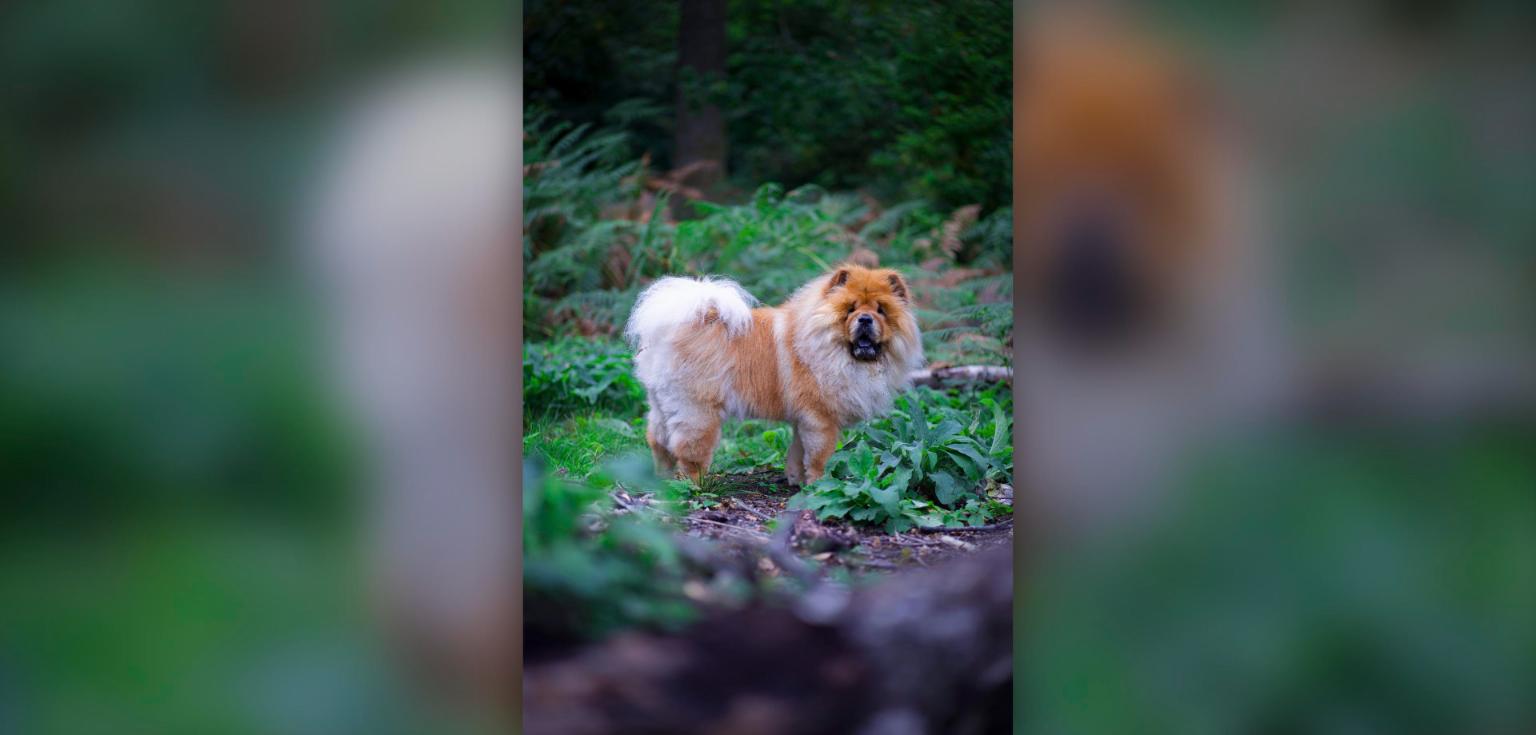
Lots of Chows look much bigger than they are. That's the coat.
Colours
The UK and FCI accept black, red, blue, fawn, cream and white, as solid colours that are often shaded but never patched. The AKC accepts red, black, blue, cinnamon and cream. Fawn and cinnamon describe the same diluted red.
Merle, patched and parti-coloured Chows sit outside all three standards. I've written a full guide to Chow Chow colours and a separate one on merle Chows.
Temperament in the standards
The UK and FCI describe the Chow as 'independent, loyal, yet aloof' and a 'good guard'. The FCI lists 'aggressive or overly shy' as a disqualifying fault. The AKC says displays of aggression or timidity are unacceptable.
So the standards aren't asking for a fierce dog. They're asking for a calm, confident, reserved one.
A word on non-standard Chows
Standards exist to guide breeding and showing. They don't decide which dogs matter. A Chow who's taller, smaller, a different colour or a cross with something else deserves exactly the same care, training and respect. Plenty of the Chows I work with would never see a show ring, and they're brilliant dogs.
Temperament
This section mixes the standards, the research and my own experience, so I'll be clear which is which.
Calm. Most Chows aren't bouncing off the walls. In my experience, a settled adult Chow is one of the most peaceful dogs you'll ever live with.
Watchful. They notice everything. The postman, the neighbour's new car, the fact that dinner is late.
Independent. Breed histories describe Chows as all-purpose working dogs, used for jobs like guarding, hunting and pulling, though early records are patchy. Many still prefer to think for themselves rather than wait for instructions. That's often mistaken for stubbornness.
Loyal, quietly. Chows tend to bond deeply with their own people. But it's a quiet loyalty. Many prefer to lie near you rather than on you.
Reserved with strangers. Plenty of Chows aren't interested in being fussed by people they don't know. That's normal, and fine. Neutral is a great result.
Clean. The AKC notes that owners describe Chows as among the cleanest of dogs, with little doggy smell, and that they often house-train easily. That matches what I see.
One more thing. Every Chow is an individual. A large 2022 study in Science looked at the genetics and behaviour of thousands of dogs and found breed explained only about 9% of the variation in behaviour between individual dogs. Breed shapes tendencies. It doesn't write a script.
For more, read Chow Chow temperament: what they're really like to live with and Chow Chow body language.
Are Chows aggressive?
This is the question I get asked more than any other.
Short answer. No breed is born aggressive, and the Chow standards all treat aggression as a fault.
Longer answer. Chows are often protective and wary of strangers. A Chow who's under-socialised, in pain, pushed around or never given space can feel they have to defend themselves. And because many Chows give quite subtle warning signals, people sometimes miss them until the dog growls or snaps.
So the answer isn't to avoid Chows. It's to:
- Socialise early and calmly, so the world isn't scary
- Learn their body language, especially the small signals
- Train force-free, because research has linked aversive methods with more stress in dogs
- Give them a safe space, and respect it
- Get a vet check for any sudden change in behaviour, because pain is a common cause
There's more in Are Chow Chows aggressive? and The dominance myth.
Training a Chow
Chows are bright. They pick things up quickly. What they don't do is repeat things for the sake of it.
Here's what works, in my experience:
- Keep sessions short. Two to five minutes beats half an hour.
- Ask once. Give them a second to think before you help.
- Pay well. Food your Chow actually wants, not the dry biscuit they'll politely ignore.
- Stop while it's going well. End on a win.
- Never use force. The AKC itself says harsh methods should be avoided with Chows. Pressure kills trust, and with a Chow trust is everything.
The skills I'd start with are a marker word, a hand touch, a settle on a mat, loose lead walking and a recall you can rely on. Have a look at why force-free training works, teaching a hand touch and building a recall.
If you want the whole thing in order, that's exactly what Chow Chow Foundations is for.
Health
Chows have some real health risks, and it's better to know them now than find out later.
The Royal Kennel Club has placed the Chow in Category 2 of its Breed Watch scheme. That means there are points of concern judges are asked to look out for.
Heat-related illness
This is the big one. In a 2020 study of UK veterinary records led by the Royal Veterinary College, Chows had the highest odds of heat-related illness of any breed studied, around 16 times the odds of Labradors. Exercise was the most common trigger.
Walk early or late in warm weather, skip walks on hot days and know the signs. Read keeping your Chow cool in hot weather.
Eyes
Chows are predisposed to entropion, where the eyelid rolls inwards and the lashes rub the eye. A UK study of vet records found nearly 1 in 10 Chows were diagnosed with an eyelid shape problem in a single year. Squinting, watering or rubbing at the face all need a vet. More in entropion and eye care.
Hips and elbows
Hip and elbow dysplasia both affect the breed. Elbows are a particular concern. In the BVA's 2025 figures, 64% of the Chows submitted for elbow grading showed some sign of elbow dysplasia.
Other conditions
The PDSA and AKC also list cruciate ligament disease, bloat (GDV), panosteitis, thyroid problems and allergies.
Health testing
- UK: BVA/Royal Kennel Club hip and elbow schemes, plus eye examinations by a veterinary eye specialist.
- US: The OFA's CHIC programme for Chows lists hips, elbows, an eye exam, thyroid and patellas.
- Elsewhere: Requirements vary, so ask the breeder what they test for and why.
See health testing for Chow Chows for what the results mean.
Lifespan
The PDSA gives an average lifespan of under 10 years. The AKC gives 8 to 12. Keeping your Chow lean, keeping them cool and catching problems early all give them the best chance. Here's how to check your Chow's weight under all that fluff.
Grooming and the coat
Chows come in two coats.
- Rough. The classic, profuse, stand-off coat with a big ruff.
- Smooth. A shorter, dense, plush coat with no obvious ruff.
Both are double coats. Both shed. Both need proper care. There's a full comparison in rough or smooth?
How often? The sources don't quite agree. The AKC says thorough brushing at least twice a week. The PDSA says every day. For most rough coats I'd aim for several thorough sessions a week, and daily during a moult.
The method matters more than the frequency. Line brush in sections, right down to the skin, so the undercoat can't mat. Brushing the top layer only is how mats hide.
A few rules:
- Don't shave a healthy double coat unless your vet advises it. It can be slow and patchy to grow back.
- Dry properly after baths and wet walks, right down to the skin, ideally with a cool dryer.
- Check ears, eyes, teeth and nails as part of the routine.
Useful reads: moulting season, how often to bath a Chow and dental care.
Exercise and heat
Chows aren't high-energy dogs, but they're not sofa ornaments either.
The Royal Kennel Club says up to an hour a day. The PDSA says a minimum of an hour, split into a couple of walks. Most Chows I know prefer steady, sniffy walks to long runs or fetch.
Mental exercise matters just as much. Sniffing, scatter feeding, puzzle feeders and short training sessions tire a Chow out without the heat risk. More in mental vs physical exercise.
And always plan around the weather. Cool days for big walks. Brain games on hot ones.
Off lead? Some Chows can, many owners prefer a long line. Read can Chow Chows go off lead? before you decide.
Living with a Chow
Children. The PDSA doesn't recommend Chows for homes with small children. Many Chows live happily with older, respectful children, with supervision and house rules. See Chows and children.
Other pets. Plenty of Chows live with other dogs and cats, especially if they've grown up together. Introductions need to be slow. See Chows and cats and introducing a Chow to another dog.
Flats. The AKC describes Chows as adaptable to city life, and many do fine in flats with enough walks and enrichment. See Chows in a flat.
Alone time. Chows can get very attached to their people. Build alone time up gradually. See how long can a Chow be left alone?
Barking. The PDSA notes Chows aren't known as big barkers, though many will let you know about comings and goings.
Water. Some Chows enjoy a paddle. Many aren't keen, and a wet coat gets heavy. See can Chow Chows swim?
What a Chow costs
The PDSA estimates a Chow costs at least £80 a month after the purchase and set-up costs, and up to £13,000 over their lifetime.
That covers food, insurance or vet savings, routine healthcare, grooming kit and the rest. Professional grooming, training, boarding and dog walking come on top if you need them.
The purchase price varies hugely. Please don't let a low price make the decision. A cheap puppy with no health tests can be the most expensive dog you ever own. There's more on this in my Chow Chow puppy guide.
History, with the caveats
The Chow comes from China. Beyond that, a lot of what you'll read online is repeated rather than proven.
You'll often see claims that Chows date back 2,000 or 3,000 years, or appear in Han dynasty artwork. Even kennel clubs repeat some of them. The honest position is that exact dates and specific ancient sources are hard to confirm.
What genetics does tell us is that the Chow has very old ancestry. DNA studies place it in a small group of 'ancient' or basal breeds, alongside East Asian breeds like the Akita and Shar-Pei. One caveat. Old ancestry doesn't mean today's Chow looked the same thousands of years ago. Like almost every modern breed, it was shaped by breed standards and kennel clubs from the late 1800s onwards.
The milestones we can confirm:
- Chow-type dogs reached Britain from the late 1700s, and London Zoo exhibited dogs from China in the 1800s
- The Kennel Club first registered the breed in 1894
- The Chow Chow Club was formed in England in 1895
- The AKC recognised the breed in 1903
Even the name is uncertain. One popular theory links it to a pidgin English term traders used for assorted goods from China. It's a nice story, but it's hard to prove.
There's more in a short history of the Chow Chow.
Is a Chow right for you?
A Chow might suit you if:
- You like a calm home and a calm dog
- You're happy to groom properly, every week, for life
- You'll plan walks around the weather
- You respect a dog who likes their own space
- You want to train with rewards, not force
A Chow might not suit you if you want a dog who loves everyone, lives for fetch, or will put up with a busy, unpredictable house. That's not a criticism. It's about the right match for you and the dog.
If you're still unsure, read is a Chow Chow right for you? and advice for first-time Chow owners. And look at rescue too. Plenty of adult Chows need homes. See adopting a rescue Chow.
A note on health. This guide is general information, not a diagnosis or a replacement for your vet. If you're worried about your Chow, or things aren't improving or are getting worse, we recommend you speak to your vet.
Sources
- The Royal Kennel Club, Chow Chow breed information and Breed Watch
- FCI, Chow Chow breed standard No. 205
- American Kennel Club, Chow Chow breed information and breed standard
- PDSA, Chow Chow breed guide
- Hall, Carter and O'Neill (2020), 'Incidence and risk factors for heat-related illness (heatstroke) in UK dogs under primary veterinary care in 2016', Scientific Reports
- O'Neill and others, VetCompass research on eyelid conditions in UK dogs, Royal Veterinary College
- British Veterinary Association, Canine Health Schemes breed statistics (2025)
- Orthopedic Foundation for Animals, CHIC programme requirements for the Chow Chow
- Morrill and others (2022), 'Ancestry-inclusive dog genomics challenges popular breed stereotypes', Science
- Parker and others (2004 and 2017), genetic studies of dog breed structure, Science and Cell Reports
Quick answers
Are Chow Chows good family dogs?
They can be, in the right home. Most Chows are calm, clean and deeply loyal to their own people, but many are reserved with strangers and don't enjoy rough handling. The PDSA doesn't recommend them for homes with small children, and they suit families who'll respect their space and train calmly.
Are Chow Chows aggressive?
Aggression isn't a breed trait you can predict from a label. The UK, FCI and AKC standards all treat aggression as a fault. Chows are often watchful and wary of strangers, so early socialisation, force-free training and respecting their signals matter a lot.
How long do Chow Chows live?
The PDSA gives an average lifespan of under 10 years and the AKC says 8 to 12 years. Individual dogs vary a lot, and health-tested parents, a lean body and regular vet checks all help.
How big do Chow Chows get?
The UK and FCI standards give 48 to 56 cm at the shoulder for males and 46 to 51 cm for females. The AKC gives 17 to 20 inches (about 43 to 51 cm) and 45 to 70 pounds (about 20 to 32 kg).
Do Chow Chows shed a lot?
Yes. Chows have a dense double coat, shed all year and usually have a heavy moult once or twice a year. Rough coats need line brushing down to the skin several times a week, and daily during a moult.
Why do Chow Chows have blue tongues?
It's pigment, decided by genetics. The breed standards ask for a blue-black tongue. Puppies are born with pink tongues that darken over the first weeks. The Chinese Shar-Pei has one too.
Are Chow Chows easy to train?
They're bright and learn quickly, but they're independent and switch off under pressure. Short sessions, good rewards and calm, consistent force-free training work far better than repetition or harsh methods.
Can Chow Chows be left alone?
Many adult Chows cope with a few hours alone once they've been taught it gradually. Puppies can't. Build alone time up slowly and get help if your Chow shows signs of distress.
Now it's your turn
If you're thinking about a Chow, pick the one section above that worries you most. Health, grooming, children, whatever it is. Read the linked guide tonight, and write down the questions you'd want to ask a breeder or rescue.
If you already have a Chow and something isn't going to plan, book a 1:1 consultation and we'll work it out together.
Want a tip like this every week? Join my free Sunday newsletter and get the Chow Chow Basics guide too.